


When working with any metal or material, one question often comes to mind: how hard is that material? The hardness basically tells you about the durability, longevity, and resistance to dents. To check this hardness, engineers rely on two tests, which are the Vickers and Rockwell hardness tests. But the challenge is that these two testing methods use different scales. This can be confusing for anyone, especially for beginners. For example, you might not understand the value written in Vickers (HV) if you are used to Rockwell values. To eliminate this confusion, the Vickers Hardness to Rockwell Conversion Chart comes into play.
But if you are new to this conversion chart, worry not! In this guide, I will explain the chart in simple terms. So let’s get started.
Overview of Vickers & Rockwell Hardness Test
Let’s first start by understanding both the Rockwell hardness and the Vickers test.
Vickers Hardness Test
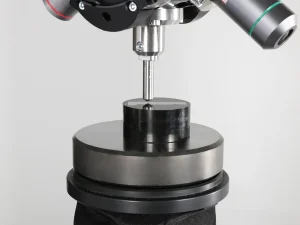
The vickers test measures a material’s hardness by pressing a diamond-shaped indenter into its surface. It calculates hardness based on the size of the indentation left behind on the material. The results are given as HV (Vickers Hardness) values. This test is known for its precision and accuracy.
If we discuss this test more deeply, it uses a Vickers hardness test machine with a small diamond-shaped tool, or indenter. This indenter is pressed into the material at a fixed force. When it hits the material surface, it forms an indentation on it. Now the size of this indentation is measured, which tells us about the hardness of the material. For example, if that mark is smaller, it means the material is harder, and vice versa.
One of the best things about the Vickers test is that it can be used for both soft and very hard materials. It uses the same type of diamond-shaped indenter and scale for all materials. This simplicity makes it simple to compare results. However, the overall process takes much time from indentation to measurement. That’s why it is not always the fastest option for industrial work.
Rockwell Hardness Test
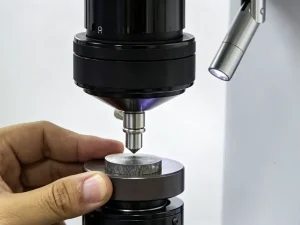
The Rockwell hardness test measures hardness by pressing an indenter into the material. But instead of checking the indentation size, it checks the depth of penetration. This, in turn, provides a direct reading without complex calculations. It uses two different scales, which are HRC and HRB.
The letter after it (like C or B) tells you which scale is used. For example, HRC is used for hard materials. However, HRB is used for softer materials. That’s why it is known for its precision, as it uses different indenters for soft and hard materials. Moreover, because it uses direct readings, the Rockwell hardness test is considered very fast.
Here, an indenter (either a steel ball or a diamond cone) is pressed into the material. When it is removed, a machine measures how deep it goes. This depth gives the direct values. For instance, if the indentation is shallower, the material is hard, and vice versa. Also, there is no need for complicated calculations. Instead, the hardness value is shown directly on the machine.
What Is a Vickers to Rockwell Conversion Chart?
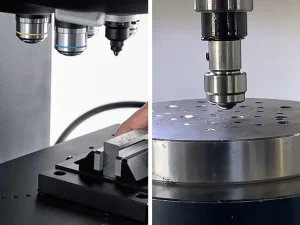
A Vickers-to-Rockwell conversion chart is a simple table that helps you convert hardness values from one scale to another. As you know, the Vickers test measures hardness by looking at the size of a small mark left on the material. It gives values in HV. However, the Rockwell test measures the depth of that mark and gives values in HRB and HRC. Right? Now, they measure hardness in totally different ways, so the numbers will never match exactly.
For example, a material with 400 HV does not mean it will also be 400 HRC. That would be wrong. That’s why there’s a conversion chart. It shows that it helps you compare and understand results when they are given in different scales. If you have done the Vickers hardness test and have an HV value, you can look across the chart and see what it is roughly equal to in Rockwell.
This comparison becomes more important when two laboratories use different hardness test methods. For example, one lab may report the hardness of the same material in Vickers, while another uses Rockwell. This is the comparison chart that will now help them determine if both materials have similar hardness. But one thing you must know is that this conversion chart is only an estimate, not a perfect conversion.
| Vickers (HV) | Rockwell C (HRC) | Rockwell B (HRB) |
| 100 HV | — | 52 HRB |
| 120 HV | — | 60 HRB |
| 180 HV | — | 79 HRB |
| 200 HV | 13 HRC | 85 HRB |
| 220 HV | 17 HRC | 89 HRB |
| 240 HV | 20 HRC | 93 HRB |
| 260 HV | 23 HRC | 96 HRB |
| 280 HV | 26 HRC | 99 HRB |
| 340 HV | 35 HRC | — |
| 360 HV | 38 HRC | — |
| 750 HV | 62 HRC | — |
How You Can Easily Use the Vickers to Rockwell Conversion Chart? Step-by-Step Guide
At first glance, the Vickers-to-Rockwell conversion chart looks very tricky and complicated. However, the good news is that it is much easier if you know some basics. To help you out, I will discuss some steps you can follow to use the Vickers-to-Rockwell conversion chart effectively.
Step 1: Note Down Your Hardness Result
First, note the hardness value you already obtained from testing. For this value, you have to perform the test whichever you want, either Rockwell or Vickers. Suppose you performed a Vickers test and the value you got is 350 HV. Now this is your reference point. Without knowing this hardness value clearly, you cannot move forward on the chart.
Step 2: Find the Nearest Value in the Chart
Next, look at the Vickers (HV) column in the conversion chart. Try to locate your exact value there. In many cases, you won’t find an exact match, and that’s normal; don’t worry. If that happens, you need to choose the nearest available value simply. Suppose you get the hardness value of 350 HV. However, you did not find it directly in the chart. Here, you can select the nearest value to that value, like 340 HV or 360 HV.
Step 3: Match It with the Rockwell Scale
You have found your Vickers hardness value in the chart, right? Next, you have to match it with the Rockwell scale. So move across the same row and try to find the Rockwell value. This is the step where conversion actually happens. Now, on the left side, you will see Vickers (HV) values. On the right, you will see Rockwell hardness values (HRC or HRB).
Both are placed in the same row because they represent the same level of hardness. So, when you locate your HV value (for example, 350 HV), you don’t stop there. Instead, you have to follow that row to the right side. There, you will see something like 36 HRC. This means that 350 HV is roughly equal to 36 HRC on the Rockwell scale.
Quick Highlight: You sometimes see only one Rockwell value (either HRC or HRB), not both. This is because Rockwell uses two different scales for different types of materials. HRB is used for softer materials. That’s why you will find it in the lower hardness range on the chart. On the other hand, HRC is used for harder materials, such as steel. So it appears in the higher hardness range. That’s why the chart does not always show both values together for every Vickers number.
Step 4: Understand & Use the Result
After you get the Rockwell value from the chart, the final step is to understand it and use it in your work. This value helps you compare your material with others that may be tested on a different hardness scale. For example, if one report shows Vickers hardness and another shows Rockwell, it will confuse you. But now, instead of two different systems (HV and HRC), you have one common value that is easy to compare and use in your work.
Why Convert Vickers to Rockwell?: Importance of Conversion Chart
In engineering, hardness values are of utmost importance. These values help them choose the right material for different projects. To make these decisions easier and more accurate, converting between Vickers and Rockwell is often crucial. But that’s not all. Here, I will share some reasons that justify the actual importance of this conversion chart.
- Easy Comparison of Different Test Results: In real industrial work, labs do not use the same hardness tests. One report may show Vickers (HV), while another shows Rockwell (HRC or HRB). This will create confusion when you try to compare materials. Right? But by converting Vickers to Rockwell, you bring both results into a common format. Now it’s much easier to compare different test results
- Helps in Better Material Selection: This conversion chart also helps choose the right material. Actually, different materials are tested on different hardness scales. So their results can look confusing. But with this comparison chart, engineers can understand all materials in one common way and quickly compare them. Now they can choose which one is actually the best.
- Compliance with International Standards: Different countries and companies follow different hardness testing systems. Some reports may use Vickers (HV), while others use Rockwell (HRC or HRB). This difference creates a problem when materials need to meet international quality standards. But a conversion chart helps solve this issue by translating hardness values into a commonly accepted format.
- Help Meet Client Specifications: Sometimes, clients specify the hardness they need for a material. The problem is that suppliers and manufacturers may test materials using different systems. Now the conversion chart helps convert the hardness value into the exact scale the client has requested. So there is no confusion or misunderstanding.
Frequently Asked Questions
Can I directly convert HV to HRC?
Yes, you can convert HV to HRC using a conversion chart. However, it is given only an approximate value, not an exact one. The reason is that Vickers and Rockwell use different testing methods. That’s why the results do not match perfectly in all cases.
Is hardness conversion always reliable?
Hardness conversion is not always fully reliable. It gives a close or approximate value, but it is not exact. That’s why you can use this chart for comparison and general understanding.
Why are there different Rockwell scales?
There are different Rockwell scales because not all materials have the same hardness. One single scale cannot measure everything correctly. That’s why in Rockwell, different scales are created—like HRB for softer materials and HRC for harder materials.
Conclusion
Before handling any material, you must know its hardness. For checking this hardness, two types of hardness tests are often performed. The first one is Rockwell, and the second is Vickers. But both systems measure hardness differently and give different results, which is confusing. To address this problem, a conversion chart is needed.
In this guide, I have discussed what this conversion chart is, its importance, and how you can use it. Basically, this chart helps you understand, compare, and use hardness values without confusion. It saves time and helps select the right materials with greater confidence. But remember that conversion values are only approximate. So, for highly critical work, actual testing is the best option.