


Every product undergoes several tests before launch. This is common across all industries. These products are tested in various machines and chambers that simulate real-world conditions. Among those, thermal chambers are beneficial testing equipment. However, many people don’t know how temperature chambers ensure product reliability.
A temperature chamber is typically used to test products that operate over a range of temperatures. Products tested in the temperature chamber are exposed to both extremely high and low temperatures. If it can withstand these extreme temperatures, it is considered reliable. In this article, I will discuss everything about temperature chambers. So, let’s get started!
What is a Temperature Chamber?
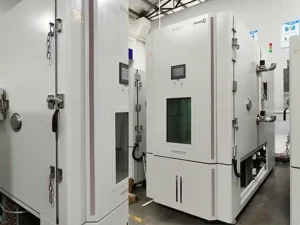
Let’s start with the basics and understand what a thermal chamber is!
A temperature chamber is a dedicated testing machine or piece of equipment. It has both a heating and a cooling system that controls temperature. The sample is placed in this chamber and is exposed to both high and low temperatures. A reliable product will withstand these conditions without cracking or failing.
As I mentioned earlier, some products are used at different temperatures. Without temperature chambers, testing products under varying conditions would be extremely challenging. Manufacturers would have to wait for winter and summer to see how samples behave in different temperatures. However, the temperature chambers are very useful because they allow operators to adjust the temperature.
Operators can ramp the temperature up and down during testing. For example, they can reduce the temperature to –40 degrees Celsius and increase it to 85 degrees Celsius. Many automotive and aircraft parts are tested at these extreme temperatures. Why? That’s because these parts are exposed to such extreme temperatures during their use.
Thermal chambers test products in accordance with ISO and IEC standards. This means the products tested in these chambers are reliable. Customers around the world trust them, which benefits manufacturers financially. Remember, this chamber has no role in product development or production. It also evaluates a product’s performance at different temperatures.
How Temperature Chambers Ensure Product Reliability?
Products tested in temperature chambers are highly reliable. Both customers and manufacturers trust such products. Their performance and longevity are what set them apart. In the section below, you’ll learn the role of thermal chambers in product reliability.
1- Simulating Real-World Temperature Conditions
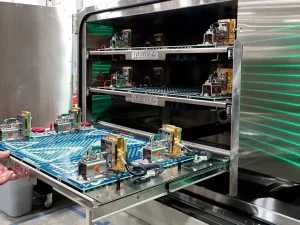
Different products are used at various temperatures. Some are designed for very high temperatures, while others are meant for room temperature. Temperature chambers allow operators to adjust the temperature as needed. This means the product experiences the same conditions it will encounter in real-world use. Operators can also ramp the temperature up or down to find the temperature at which products fail. These simulations make temperature chambers highly reliable for product testing.
2- Identifying Weak Materials and Components
Temperature chambers play a key role in identifying weak materials. The operator monitors the product’s condition throughout the testing process. For example, if you place a product in the chamber and begin the test, it quickly deteriorates as the temperature rises. This indicates that the material is not of high quality. Identifying weak materials early in the testing phase is crucial. Manufacturers can then make improvements to ensure the products become more reliable.
3- Reliable Performance in Cold and Hot Environments
As mentioned above, a temperature chamber can expose a product to extreme temperatures. This gives manufacturers a clear idea of what happens when a product is subjected to high temperatures. Some products are designed for use at moderate temperatures—e.g., batteries. But sometimes these products can unexpectedly encounter very high temperatures. If they aren’t tested, they may malfunction or even crack. Therefore, thermal chambers ensure products perform reliably at both extremes. This helps prevent accidents if the product is accidentally exposed to very high or very low temperatures.
4- Long-Term Durability and Lifespan
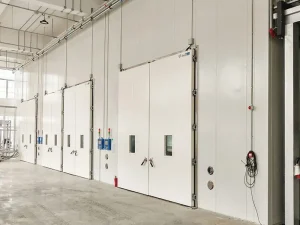
Temperature chambers help assess a product’s durability and lifespan. During testing, operators raise the temperature to determine at what point the product fails. If this failure temperature is very high, it means the product is reliable. Additionally, manufacturers typically list this temperature as a very high value that must be avoided. So customers handle the product more carefully and don’t exceed the maximum temperature limit. This ultimately helps the product last longer in real-world use.
5- Minimize the Risk of Sudden Failures of Products
Have you ever seen a product suddenly failing due to temperature fluctuation? This is very common in temperature-sensitive products or items. However, temperature chamber testing reduces the risk of sudden product failure. This is because the chamber is exposed to fluctuating temperatures. First, the product is exposed to high temperatures, and then the operator reduces the temperature. This sudden decrease in temperature from high to low checks the reliability of the products. This way, it ensures the product functions correctly when exposed to varying temperatures.
Components of the Temperature Chamber
The temperature chamber seems like a standalone machine. However, it consists of components that work together to enable these chambers to perform their function. Here is the list of these components that make up the fully functional thermal chamber:
- Enclosed space
- Heating System
- Cooling System
- Control Panel
- Air Circulation Fans
- Insulated Outer Body
The enclosed space is where the sample is placed. It is typically made of sturdy material such as stainless steel. The outer body of these chambers is also built to withstand strong forces. This ensures no heat from inside the chamber escapes. If this happens, the chamber won’t be able to maintain a stable temperature. The chamber also contains an electric heating system.
Similarly, the chamber’s cooling system uses a refrigeration system. Their role is to lower the chamber’s temperature when needed. Additionally, each chamber contains small fans. Their role is to ensure every side of the sample is exposed to the same temperature. These fans evenly circulate hot or cold air throughout the chamber.
How Do Temperature Chambers Work?
The working of a temperature chamber is relatively straightforward. These chambers include heating elements and cooling components to raise and lower temperatures. Additionally, operators adjust the temperature from the digital screen. In the section below, I explain the working of these chambers:
- First, the product or sample is placed in the temperature chamber. This product can be anything or of any size. The reason is that thermal chambers are larger and accommodate the sample more easily.
- Once the sample is placed, the operator sets the desired temperature. Remember, these chambers have digital screens to adjust the temperature. Operators adjust the temperature based on the type of product being tested.
- If the temperature set is too high, the heat element starts to work. It produces heat, increasing the temperature inside the chamber. Remember, this temperature rise is slow and can take some time.
- On the other hand, if the temperature gets too low, the cooling system kicks in. This system uses either compressors or cooling coils to lower the temperature. The temperature inside the chamber starts to drop. When it reaches the set limit, the chamber begins to stabilize, meaning the temperature inside stays constant (at the set point). This way, the product is exposed to the specified temperature for an extended period.
- During this time, operators monitor the product’s condition. If the product remains stable, the operator then quickly increases and decreases the temperature. This cyclic change further tests the product against sudden temperature rises and falls. If the product holds up, it indicates excellent durability—and vice versa.
Applications of Temperature Chambers
The use of temperature chambers is not limited to specific applications. Instead, these chambers can be used to test any sort of product. From batteries to smartphones and other electronics, the scope of these chambers is vast. However, the aerospace and automotive industries benefit significantly from these chambers.
Aircraft parts are exposed to both high and low temperatures. These parts are tested to ensure they won’t fail under extreme temperatures. Similarly, automobile engine parts get extremely hot during operation. So manufacturers test these engine parts against high temperatures to ensure durability.
Here is the table showing the applications of temperature chambers:
| Industry | Applications of the Temperature Chamber |
| Electronics | Testing circuit boards, sensors, and mobile phones |
| Automotive | Testing batteries, ECUs, and engine components |
| Aerospace & Aviation | aircraft electronics, materials, structural parts |
| Pharmaceuticals | Shelf-life validation, vaccine storage |
| Battery & Energy | Battery performance, thermal safety, and charging behavior |
| Research & Development | Prototype testing and material research |
Conclusion
In conclusion, temperature chambers are one of the most essential devices. Their primary role is to test the product against both low and high temperatures. If the product is of low quality, it would crack when exposed to extreme temperatures.
This testing has become a standard for manufacturers. Why? That ensures every product launched is reliable and that customers don’t face problems while using it. In this article, I have discussed temperature chambers and how they ensure product reliability. You’ll also learn about basic working and the contents of these chambers.